
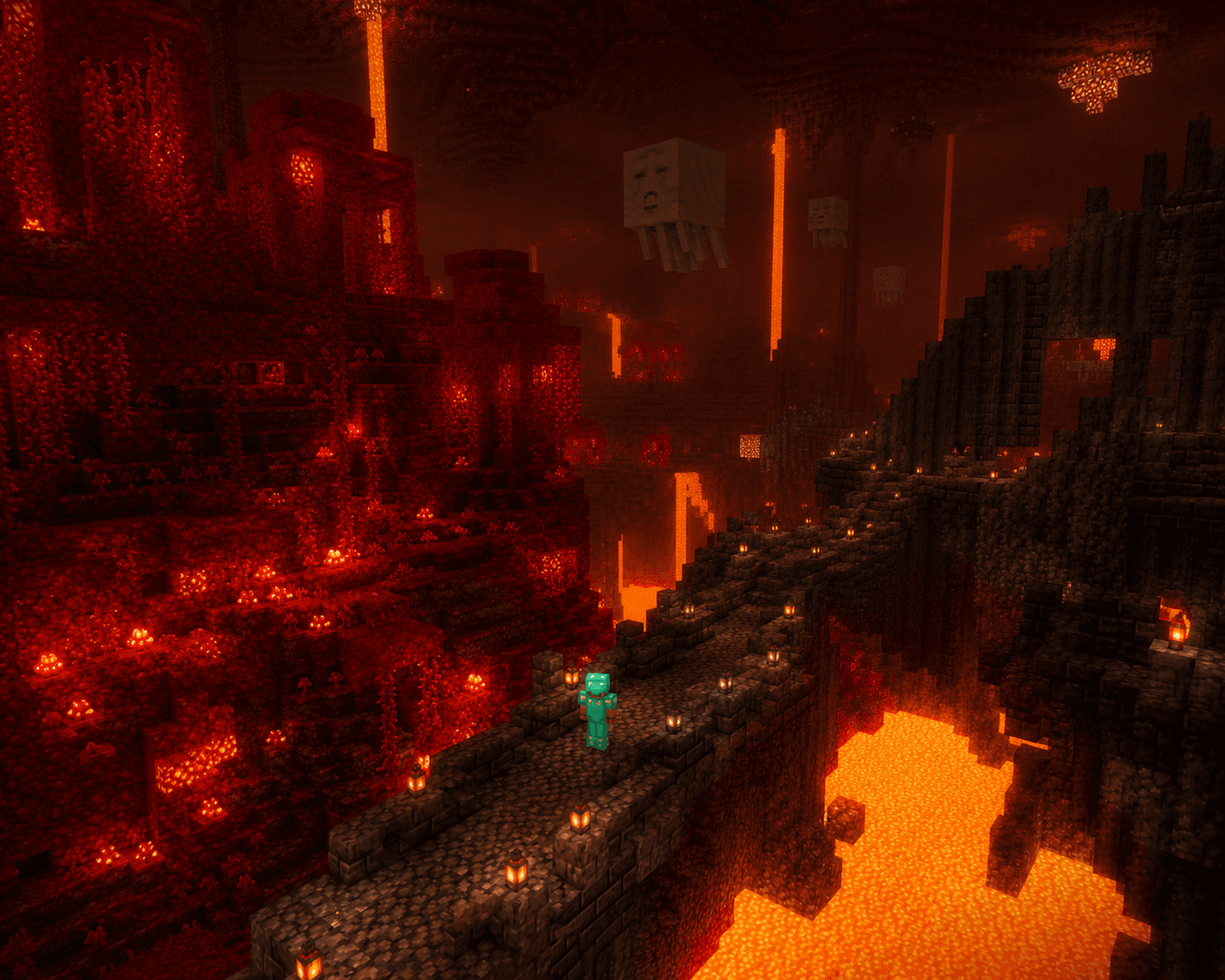

The Nether is one of the most dangerous places in Minecraft. Lava lakes stretch as far as you can see. Ghasts bombard you from the air. Piglins attack on sight. And fall damage is everywhere because the terrain drops off into lava without warning. Yet the Nether is also one of the most important dimensions in the game — it's where you find Blaze Rods for potions, Ancient Debris for Netherite, Nether Fortresses, and a huge variety of materials you simply can't get in the Overworld.
This guide will teach you how to survive, navigate, and thrive in the Nether from your very first visit.
Before You Go: Essential Preparation
Going into the Nether underprepared is a death sentence. Before stepping through that portal, make sure you have the right gear.
Minimum Gear Requirements
You don't need perfect gear for early Nether runs, but you do need decent protection:
- Iron armor or better — Stone armor doesn't exist, so iron is your minimum. Enchanted gold armor is actually viable in the Nether because Piglins won't attack you if you're wearing at least one piece of gold.
- A shield — This blocks Ghast fireballs when timed correctly.
- A sword — Iron or better. Fire Aspect is great in the Nether since many mobs are immune to fire, but it at least applies to Piglins.
- A bow with plenty of arrows — Essential for Ghasts, which you need to fight from a distance.
- Food — Bring at least 20 cooked food items. The Nether has no passive food regeneration if you're at full hunger.
- Fire Resistance Potions — These are optional for early trips but highly recommended. They make you immune to fire and lava, which are everywhere.
- Building blocks — Bring cobblestone or any non-flammable block. Netherrack burns forever, so don't use it for building shelters.
- Flint and Steel — To relight your portal if Ghasts blow it out.
Gold Armor: The Piglin Trick
This is one of the most important survival tips for the Nether: always wear at least one piece of gold armor. Piglins are neutral mobs — they'll leave you alone as long as you're wearing gold. Without it, every Piglin and Piglin Brute in sight will attack you, which is absolutely lethal in groups.
The cheapest option is to craft gold boots and wear them. That's one piece of gold armor, and it's all you need.
Understanding the Nether Biomes
The Nether isn't one uniform wasteland anymore. It has five distinct biomes, each with different threats and resources:
Nether Wastes — The classic reddish-orange Nether you know. Netherrack everywhere, lava lakes, Ghasts, Piglins, and Hoglins. This is the most common biome and a good place to find Nether Fortresses.
Crimson Forest — Red mushroom trees, dense fungal ground cover, and tons of Piglins and Hoglins. The wood here (Crimson Wood) is a great early building material. Hoglin meat is excellent food — but Hoglins are aggressive, so be careful.
Warped Forest — Blue-green biome with warped trees. This is actually the safest Nether biome — Endermen live here, but they won't attack unless provoked. No Piglins spawn here. Great for exploring safely.
Soul Sand Valley — A grey, fog-filled biome with Soul Sand, Soul Soil, and Bone blocks. Skeletons and Ghasts spawn here in large numbers. Gorgeous but dangerous. Soul Speed enchantment lets you move quickly on Soul Sand.
Basalt Deltas — Black and grey volcanic biome with tons of Magma Cubes. Difficult terrain with large drops and lava patches. Rich in Blackstone, which is a great substitute for Cobblestone.
The Biggest Threats — And How to Handle Them
Ghasts
Ghasts are the Nether's most iconic threat. These giant floating creatures shoot explosive fireballs that deal massive damage and can blow apart your Nether portal.
How to deal with them: Shoot Ghasts with your bow before they can get a shot off. Aim for the small glowing red eye area when the Ghast opens up to fire — that's when it takes full damage. You can also deflect fireballs back at Ghasts by hitting them with your hand, a sword, or a bow (deflected fireballs one-shot Ghasts and earn you the "Return to Sender" advancement). A shield can block fireballs entirely if timed right.
Stay calm — Ghasts have a long wind-up before they fire. You usually have time to move sideways and then shoot.
Piglins and Piglin Brutes
Regular Piglins ignore you if you wear gold. Piglin Brutes wear no armor, have axes, and attack you regardless of your gold. Brutes only spawn in Bastion Remnants. Avoid engaging Piglin Brutes unless you're well-armed.
You can also barter with Piglins by throwing Gold Ingots at them. They'll pick up the ingot and toss you a random item — often Fire Resistance Potions, Ender Pearls, Obsidian, or even Crying Obsidian.
Blazes
Blazes are found inside Nether Fortresses and spawn from Blaze Spawners. They shoot fire charges in rapid bursts and can fly, making them hard to dodge in tight spaces.
How to deal with them: Snowballs deal 3 damage per hit to Blazes — bring a stack of snowballs for an efficient and cheap counter. Swords work too if you can close the gap. Fire Resistance Potions make Blaze fights trivial.
Magma Cubes
Found in Basalt Deltas and occasionally elsewhere, Magma Cubes bounce toward you and deal fire damage. Large Magma Cubes split into smaller ones when killed. Deal with the smallest size first to prevent getting overwhelmed. A strong sword clears them quickly.
The Lava
Lava is the Nether's most deadly hazard — not because it kills you fast, but because it destroys your items. If you die in lava, everything you were carrying burns. Always stay away from lava edges, never sprint near lava lakes, and build safe paths before crossing dangerous terrain.
Navigation: Don't Get Lost
Getting lost in the Nether is terrifyingly easy. The terrain all looks the same, and the 1:8 coordinate scale (1 Nether block = 8 Overworld blocks) means you can travel enormous distances in Overworld terms very quickly.
Mark Your Portal
The moment you step through your portal, immediately mark it. Place distinctive blocks around it or build a small marker tower. Name a map "Nether Portal" and use it. The worst thing that can happen is losing your portal location.
Use the Coordinate System
Press F3 to open the debug screen and check your coordinates. Write down your portal's X, Y, Z coordinates before exploring. This lets you always navigate back.
Build Paths
In the Nether, build cobblestone paths as you go. This gives you a trail to follow back home and creates safe footing over dangerous terrain. Cobblestone is fireproof, ghast-blast-resistant, and cheap to bring.
Finding Key Structures
Nether Fortresses
Nether Fortresses are massive brick structures with long corridors, Blaze Spawners, and Nether Wart gardens. These are essential — you need Blaze Rods for Blaze Powder (for Eyes of Ender and potions) and Nether Wart to start brewing.
Nether Fortresses tend to generate in Nether Wastes biomes and run roughly north-south. If you're not finding one, try traveling east or west rather than north or south.
Bastion Remnants
Bastions are large ruined fort structures home to many Piglins and Piglin Brutes. They contain some of the best loot in the Nether including Netherite gear, gold blocks, and magma cream. Approach carefully — Piglin Brutes will attack you on sight regardless of gold armor.
Ancient Debris: Finding Netherite
Ancient Debris is the rarest ore in the game and is used to craft Netherite. It generates between Y=8 and Y=22, with the highest concentration around Y=15. Here's how to find it efficiently:
Mine long horizontal tunnels at Y=15. Ancient Debris only spawns exposed to air on at most one side, so strip mining or bed mining (placing beds and activating them in the Nether to cause explosions) are the fastest methods. You need 4 Ancient Debris per Netherite Ingot (combined with 4 Gold Ingots), and 4 Netherite Ingots per full armor set. It's rare, so don't be discouraged if early trips yield little.
Quick Nether Survival Tips
Bring a Fire Resistance Potion on every trip once you can brew. Being immune to fire and lava turns the Nether from lethal to manageable.
Never jump blindly. Always check the terrain below before dropping. Many Nether deaths come from falling into unexpected lava.
Sleep equals death (literally). Don't try to sleep in the Nether — beds explode violently when activated there. You can use this intentionally for mining, but never place a bed accidentally.
Respawn anchor is your friend. If you plan to spend a lot of time in the Nether, build a Respawn Anchor (crafted with Crying Obsidian and Glowstone) and charge it with Glowstone Blocks. This lets you respawn in the Nether instead of back at your Overworld spawn.
Piglins hate it when you open their chests. Even with gold armor, opening a chest near Piglins makes them hostile. Kill the Piglins in a room first before looting.
Building a Nether Base
If you plan to spend significant time in the Nether, consider building a small outpost. Use non-flammable materials like Cobblestone, Stone Brick, Blackstone, or Nether Brick. Netherrack burns forever and should only be used decoratively.
A good outpost has a bed (which you'll never use in the Nether, but it looks good), a chest for overflow items, a crafting table, and a furnace. Most importantly, it should have clear sightlines in all directions so Ghasts can't sneak up on you.
Final Thoughts
The Nether is punishing but fair. Almost every danger can be avoided with patience, the right gear, and awareness of your surroundings. The rewards — Netherite, Blaze Rods, Nether Wart, Ender Pearls from bartering, and Nether-only building materials — are well worth the risk.
Go in prepared, move carefully, mark