
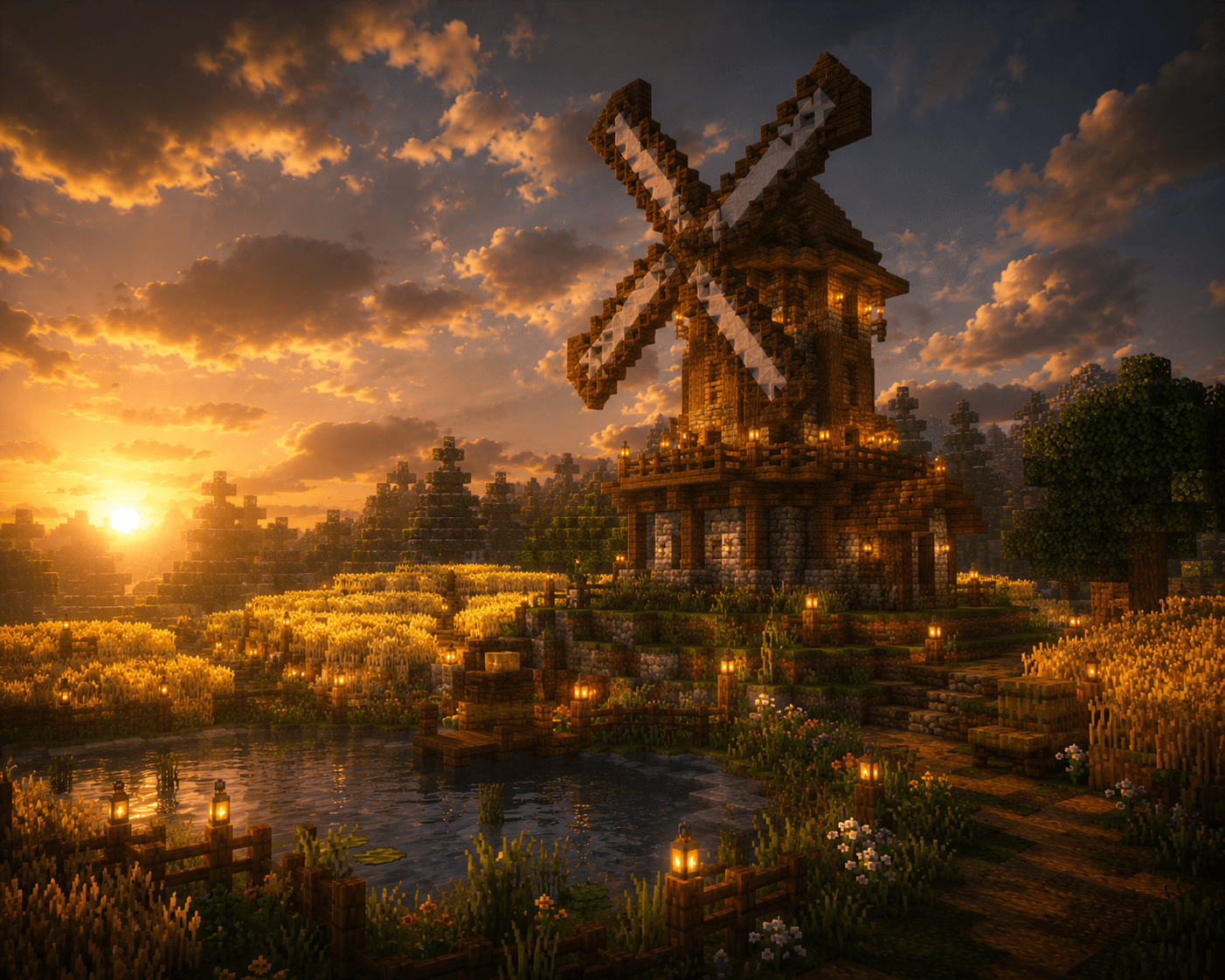

A windmill is one of those builds that instantly makes a base feel alive. Perched next to a wheat field or overlooking a pond, its rotating blades add motion and charm to an otherwise static landscape. Best of all, it's a beginner-friendly build that doesn't require redstone or complicated mechanics — just some patience and a good block palette. Here's how to build your own.
Planning Your Windmill
Before placing a single block, decide on:
- Location. Windmills look best on a small hill, next to farmland, or beside water. Elevation helps sell the "functional" look, since real windmills are usually built where wind is strongest.
- Size. A base tower of 5x5 or 7x7 blocks works well for a classic cottage-style windmill. Bigger footprints let you add more detail but take longer to build.
- Palette. Cobblestone, spruce planks, and stripped logs give a rustic, old-world feel. Stone bricks and dark oak create a slightly more medieval look.
Step 1: Build the Base Tower
Start with a cylindrical or square tower, tapering slightly as it rises to mimic a real windmill's silhouette.
- Lay out a 7x7 circle (or square, if you prefer a simpler build) using cobblestone or stone bricks for the lower half.
- Build upward about 10-12 blocks, switching to spruce planks or logs for the upper section to create a visual break between "stone base" and "wooden top."
- Add windows using fences or glass panes spaced evenly around the tower — 2-3 rows work nicely.
- Cap the tower with a conical roof using stairs, narrowing the shape by one block per layer as you go up.
Step 2: Build the Rotating Blades
The blades are the heart of the windmill, even though they won't actually spin without command blocks or resource packs (in vanilla survival, they stay static — and that's completely fine).
- Attach a central hub to the front-facing side of the tower, just below the roof.
- Build four blades extending outward in an X pattern, each 6-8 blocks long.
- Use fences or dark oak trapdoors for the blade frame, and fill in the panels with wool, painted terracotta, or trapdoors angled to look like fabric sails.
- Angle the blades slightly (using stairs or trapdoors at an angle) to give the illusion of motion, as if caught mid-spin.
Step 3: Add Supporting Details
A windmill rarely stands alone. These small touches make the whole scene feel intentional:
- A wheat or flower field surrounding the base ties the build into a farm theme.
- A small pond or stream nearby adds reflections and a peaceful atmosphere.
- A wooden fence and path leading up to the door invites players to walk closer.
- Lanterns or torches along the path and around the tower give it a cozy glow at night.
- Barrels, hay bales, and crates scattered near the entrance suggest the windmill is actually used for storing grain.
Step 4: Interior (Optional)
If you want the windmill to be more than just decoration, add a simple interior:
- A ground floor with a furnace, crafting table, and storage barrels — themed as a small mill workspace.
- A ladder or stairs leading up through the tower.
- A top floor near the blades with a bed and a window overlooking the fields — perfect as a small home base.
Tips for a Better-Looking Windmill
- Avoid perfectly flat walls. Add small overhangs, exposed beams, or stair details to break up large surfaces.
- Mix wood types. Combining spruce and dark oak (or oak and stripped logs) adds subtle texture without looking messy.
- Use color sparingly. A single accent color, like red or blue wool on the blades, stands out more than a rainbow of colors.
- Build at golden hour. If you're taking screenshots, windmills look especially good silhouetted against a sunset.
Blade Variations
The X-pattern is classic, but you're not limited to it:
Pinwheel pattern: Four blades but rotated 45 degrees, creating an offset square look. More visually interesting than straight X.
Double windmill: Two sets of rotating blades on opposite sides (or one set on top, one on bottom). More complex but dramatic.
Fan-style blades: Six or eight smaller blades arranged in a circle instead of four large ones. Looks more modern and industrial.
Each variation has a different feel. X-pattern = classic medieval. Fan-style = Dutch-inspired. Pinwheel = slightly magical/stylized.
Common Building Mistakes
Too tall, no taper: A straight cylinder tower feels boring. Tapering inward as you rise (getting slightly narrower per layer) makes it look intentional and architectural.
Blades too thin: Blades made from just sticks or fence posts look fragile. Use solid blocks in the frame (spruce logs) and thicker panels (multiple layers of wool or trapdoors) for weight.
No door or entrance: A windmill that's just a tower is decoration. Adding a door and a ground-floor room makes it feel real—like someone lives there or uses it.
Inconsistent palette: Using seven wood types at once looks chaotic. Pick 2-3 main blocks and stick with them.
Why Build a Windmill?
Beyond aesthetics, windmills teach you how to combine shapes—cylinders, cones, and extensions—into something cohesive. You're not following a grid; you're thinking about how real structures work.
They also establish theme. A windmill immediately signals "countryside," "agricultural," "peaceful." Plop one down and suddenly your base has an identity instead of just being a pile of buildings.
Whether solo or as part of a larger village project, windmills are one of those builds that make you proud to show your world to others. They look complex but they're fundamentally just a tower with details. That gap between perception and difficulty makes them deeply satisfying to build.