
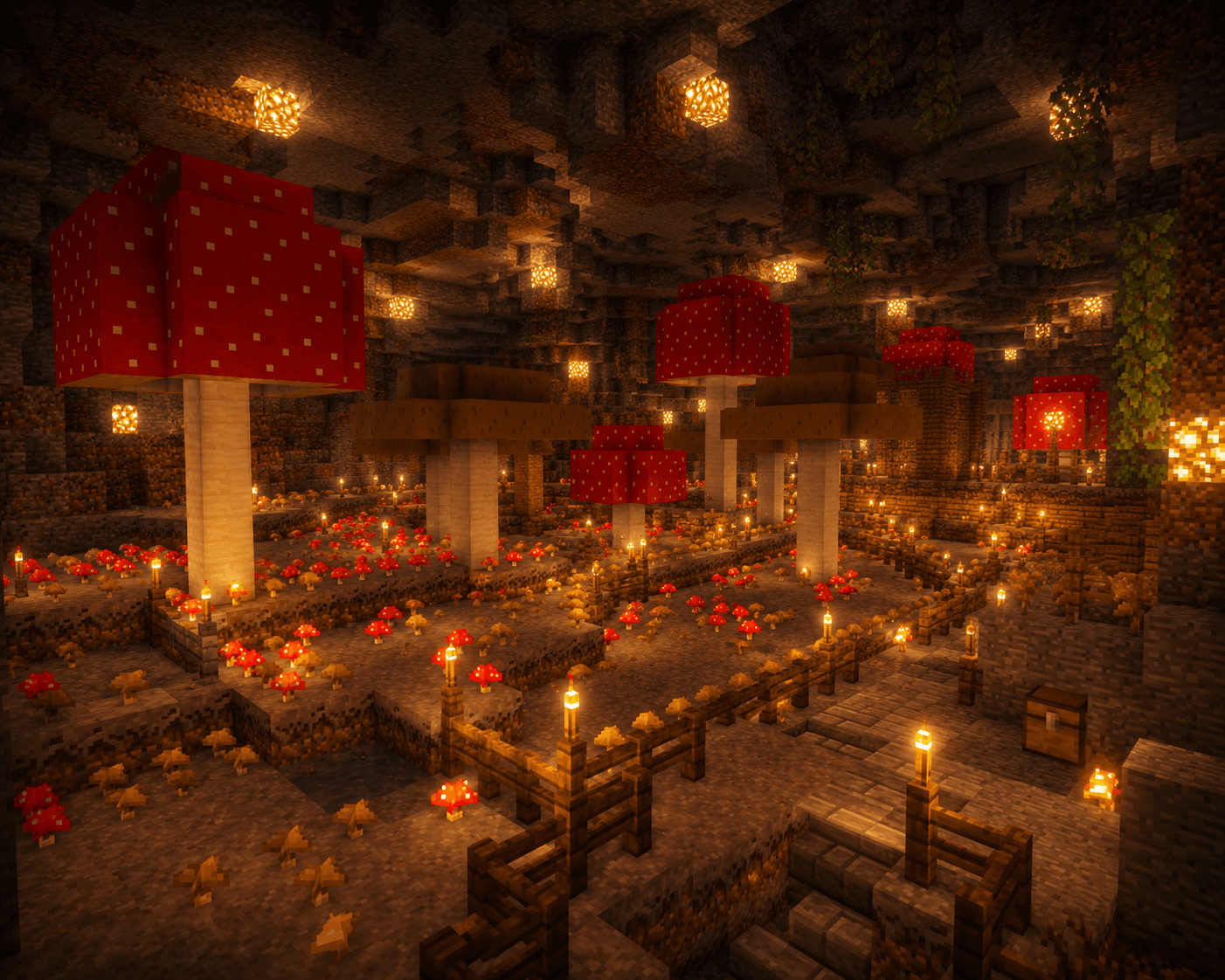

Mushrooms are one of the most useful renewable resources in Minecraft. They are the core ingredient in mushroom stew — one of the best early-game food sources — and essential for rabbit stew, fermented spider eyes for brewing, and suspicious stew with status effects. The problem is that mushrooms are slow to find and annoying to gather in the wild. The solution is a dedicated mushroom farm that produces as many as you need automatically.
This guide covers several farm designs, from a simple starter setup to a fully automated giant mushroom farm that produces hundreds of mushrooms per harvest.
How Mushroom Growth Works
Mushrooms spread slowly under the right conditions. Understanding the mechanics helps you build a more efficient farm.
Mushrooms spread to adjacent blocks (including diagonally) every 25 game ticks if certain conditions are met: the target block must be empty, must be a solid opaque block on top, and must be at light level 12 or below. A single mushroom can spread to up to 5 adjacent blocks.
However, there is a key constraint: mushrooms cannot spread if there are already 5 mushrooms within a 9x9 area centered on the spreading mushroom. This caps natural spread and is why wild mushroom patches stay small.
Giant mushrooms bypass this cap entirely. A small mushroom grown with bone meal instantly becomes a giant red or brown mushroom, producing 20-40 small mushrooms when broken. This is the basis for the most efficient farms.
Mushroom Varieties
Red Mushrooms — The common small mushroom. Found in dark areas, caves, and mushroom biomes. Used in mushroom stew and suspicious stew.
Brown Mushrooms — Slightly rarer, often found near swamps and dark oak forests. Also used in mushroom stew. Brown giant mushrooms have a larger cap and produce more mushrooms per bone meal than red giants.
Both types are interchangeable for mushroom stew and most recipes. Brown mushrooms are slightly more efficient for giant mushroom farming.
Design 1: Simple Underground Farm
The easiest mushroom farm is a small underground room optimized for passive spread.
Materials
- Building blocks of any type (around 100)
- 4-8 mushrooms (red or brown)
- A few torches (carefully placed)
- Bone meal (optional, for faster setup)
Construction
- Dig out a room 9x9 blocks wide and 3 blocks tall underground
- The floor must be a solid opaque block — dirt, stone, or any standard block works
- Do not add torches inside the room — mushrooms need darkness. Light the entrance only
- Place mushrooms on the floor, spacing them at least 5 blocks apart so their spread areas do not overlap immediately
- Close off the room and come back every few Minecraft days — the mushrooms will have spread
Output: A 9x9 room produces a slow but steady supply. Break mushrooms when the room fills up and replant 4-8 starters. Collect the rest.
Limitation: Slow. Good for early game but not enough for heavy potion brewing or regular stew cooking.
Design 2: Giant Mushroom Farm
This design uses bone meal to instantly grow giant mushrooms, then breaks them for a large batch of small mushrooms. It is the most efficient design for manual farming.
Materials
- Building blocks (around 200)
- Bone meal (farm bones from a skeleton spawner or bone meal farm)
- 1-4 mushrooms to start
- A good pickaxe or sword for breaking mushroom caps
Construction
Room dimensions are critical: Giant brown mushrooms grow up to 7 blocks tall and the caps extend 7 blocks wide. Giant red mushrooms can be 5-7 blocks tall with a 5-wide cap. Build your room 8 blocks tall and at least 9x9 wide to accommodate full giant growth.
- Dig out the room 9 wide x 9 deep x 8 tall
- Light level inside must be 12 or below — use a single torch in one corner only, or a dim redstone lamp
- Place mycelium or podzol as the floor material — mushrooms can grow on mycelium and podzol at any light level, which gives you more flexibility. Dirt and stone require low light
- Place a single mushroom in the center of the room
- Use bone meal on the mushroom — it instantly grows into a giant mushroom
- Break the mushroom cap blocks (not the stem) by hitting them — they drop 0-2 mushrooms per block
- A full brown giant mushroom cap has 25+ blocks, yielding approximately 10-25 small mushrooms per bone meal used
- Replant one mushroom and repeat
Output: Each bone meal converts to approximately 10-25 mushrooms. With a skeleton farm or bone meal farm running, this scales to hundreds of mushrooms per minute of active farming.
Design 3: Automatic Mushroom Farm
For fully passive mushroom production, combine a mushroom spreading room with a water flush collection system.
Materials
- Building blocks (around 300)
- Mushrooms to seed the farm
- Water buckets (2-4)
- Hoppers (8-12)
- Chests (2-4)
- Dispensers (2, for automated flush — optional)
- Redstone (for automated version)
Construction
The Spreading Layer:
- Build a flat room 13x13 wide and 2 blocks tall
- Place mycelium on the entire floor
- Seed with mushrooms spread across the room — one every 5 blocks
The Collection System:
- At one end of the room, dig the floor down 1 block to create a collection trench
- Place hoppers in the trench feeding into chests below
- On the wall opposite the trench, place water source blocks — when activated, water flows across the entire floor and pushes mushrooms into the trench
- Hoppers collect everything automatically
Automated Flush:
Connect the water source dispensers to a redstone timer. Set it to activate every 10-15 minutes of game time. The farm fills with mushrooms, the timer triggers, water pushes them into the hoppers, and chests fill passively.
Output: A 13x13 automated farm produces 30-60 mushrooms per flush cycle, entirely passively.
Mushroom Farming Tips
Use Mycelium or Podzol
Mycelium is the most important upgrade for any mushroom farm. Mushrooms on mycelium grow at any light level — including full daylight. This means you can build mushroom farms above ground, in bright rooms, and without worrying about light management at all. Get mycelium from a mushroom island biome.
Podzol works the same way and is easier to get — it generates naturally in giant spruce taiga biomes and can be obtained with Silk Touch.
Bone Meal Source
The giant mushroom design depends on bone meal. The most efficient source is a skeleton spawner farm, which generates bones automatically. Alternatively, composters convert plant material into bone meal — feed a composter with excess seeds, flowers, or leaves and it produces bone meal passively.
Mushroom Stew Automation
Once you have a reliable mushroom supply, set up a mushroom stew auto-crafting station. Place a bowl, red mushroom, and brown mushroom in a crafting table or use auto-crafters (available in 1.21) to produce stew continuously. Mushroom stew restores 3 hunger bars and 3.6 saturation — efficient early-game food.
Suspicious Stew
Different flowers added to mushroom stew create suspicious stew with status effects. Azure bluet gives Blindness, dandelion gives Saturation (very powerful), oxeye daisy gives Regeneration. Farming mushrooms enables this potion-like food crafting without a brewing stand.
FAQ
Q: Why are my mushrooms not spreading? A: Check the light level — if it is above 12, mushrooms will not spread (unless on mycelium or podzol). Also check spacing — if 5 mushrooms are already within the 9x9 spread range, spreading stops. Harvest the farm and replant with fewer starters.
Q: Can mushrooms spread on any block? A: Mushrooms spread onto most solid opaque blocks. They cannot spread onto glass, slabs, stairs, or transparent blocks. On mycelium and podzol they spread regardless of light level.
Q: How do I get mushrooms to start a farm? A: Check dark areas in caves — mushrooms are common at light level 7 and below. Swamp biomes have brown mushrooms on the surface. Mushroom island biomes have mushrooms everywhere. Even witch huts in swamps often have a mushroom inside.
Q: Do giant mushrooms drop more than small mushrooms when broken? A: Giant mushrooms break into small mushrooms — each cap block drops 0-2 small mushrooms. A full giant brown mushroom has around 25 cap blocks, yielding roughly 12-25 small mushrooms. This is significantly more efficient than waiting for natural spread.
Conclusion
A mushroom farm pays for itself quickly. A simple underground room handles early game needs. A giant mushroom setup with bone meal handles mid and late game potion and food demands. An automated flush farm handles everything passively while you focus on other projects.
Start with the simple design and upgrade when your bone meal supply is reliable. Once you have an automated farm running, mushrooms become one of the most effortless resources in your entire base.
For your next farm project, check out our guide on building an automatic bamboo farm — one of the simplest fully automated farms in the game.