
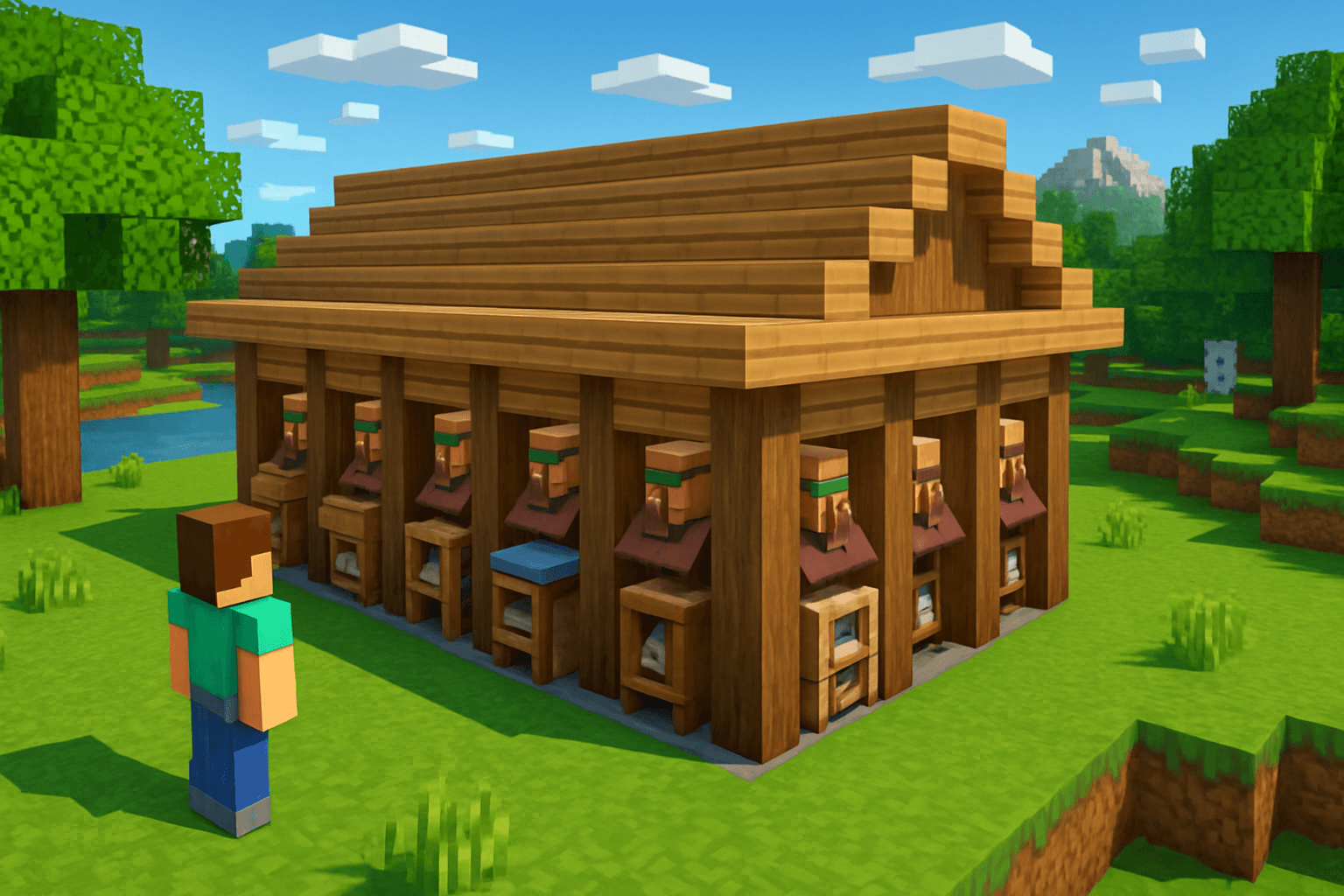

A trading hall is the endgame backbone of any serious survival Minecraft world. This guide focuses on the actual construction — how to build it, how to lay out cells, and how to keep your villagers happy and productive.
Planning Your Trading Hall
Before placing a single block, decide on two things:
- How many villagers? Start with 6 to 10 for a compact hall. Scale to 20+ as your world progresses.
- Underground or surface? Underground protects from raids and weather. Surface builds are easier to expand.
The design covered here is underground and modular — each cell is identical, so you can expand in either direction endlessly.
Materials List
For a 10-cell trading hall:
- Stone Bricks — 128 (walls and floor)
- Glass Panes — 20 (cell fronts for trading)
- Slabs (any stone) — 64 (ceiling and flooring detail)
- Beds — 10 (one per villager)
- Job Site Blocks — 10 (one per villager, matching their profession)
- Trapdoors — 20 (for blocking pathfinding while allowing trading)
- Torches or Lanterns — 20 (lighting)
- Carpets — 10 (prevents mob spawning and looks clean)
Single Cell Design
Each villager gets their own cell. A standard cell is 1 wide, 3 deep, and 2 tall:
- Back: Bed placed against the back wall
- Middle: Job site block (lectern, composter, blast furnace, etc.)
- Front: Glass pane or trapdoor so you can trade without entering the cell
The villager stands at the job site block during the day and you interact through the glass pane.
Place a trapdoor on the floor in front of the cell entrance. When closed, it keeps the villager from pathfinding out. When you want to trade, open it momentarily and right-click the villager.
Some builders use a half-slab floor raised one block and a full block gap at villager eye level so trading is possible without opening anything.
Building the Hall Layout
Lay out a corridor 3 blocks wide and as long as you need. Cells line both sides of the corridor, facing inward.
Here's the cross-section:
- Cell (3 deep) | Corridor (3 wide) | Cell (3 deep)
Each cell is separated from the next by a single stone brick wall. This prevents villagers from linking to each other's beds or job sites.
Roof the corridor 3 blocks high for comfortable walking space.
Add carpet on every cell floor. This prevents mobs from spawning inside cells in case lighting drops, and it looks much cleaner.
Lighting
Light the entire hall to light level 8 minimum in every cell and the corridor.
Lanterns hung from the ceiling in the corridor look great and provide ample coverage. Place torches or embedded lanterns inside each cell.
Never leave dark corners. A zombie in your trading hall will turn your villagers into zombie villagers — frustrating and costly.
Preventing Zombie Attacks
Seal all entrances. Use iron doors with button access from outside so the hall only opens when you need it.
If you're on a server or in an area with raiding, add a second layer of protection: a perimeter fence around the underground entrance with bright lighting.
Sorting Villagers Efficiently
Label each cell with an item frame above it showing what the villager sells. Common setups:
- Row 1: 3x Librarian (Mending, Silk Touch, Fortune)
- Row 2: 2x Farmer (emerald generation)
- Row 3: 1x Armorer, 1x Weaponsmith, 1x Toolsmith
- Row 4: 1x Cleric (ender pearls), 1x Cartographer
Curing Villagers After Moving
If you transport zombie villagers to cure them in the hall, make sure to cure them after placing them in their final cell. Cured villagers keep their discounts permanently, but the cure discount only applies to the cell they're in when cured.
Cure process:
- Trap the zombie villager in the cell.
- Throw a Splash Potion of Weakness at them.
- Use a Golden Apple.
- Wait 3-5 minutes. Done.
Scaling Up
The modular design makes expansion easy. When you need more trades, just dig the corridor longer in either direction and add more cells.
For a mega-hall (50+ villagers), split professions into separate wings. All librarians in one area, all farmers in another. This keeps navigation quick and logical.
Final Thoughts
A trading hall seems like a big project, but a 10-cell version takes less than an hour to build with materials on hand. The return on investment is enormous — unlimited emeralds, Mending on every piece of gear, and enchanted tools for a fraction of the XP cost.
Build it once. Cure your villagers. Your survival world will never feel the same.