
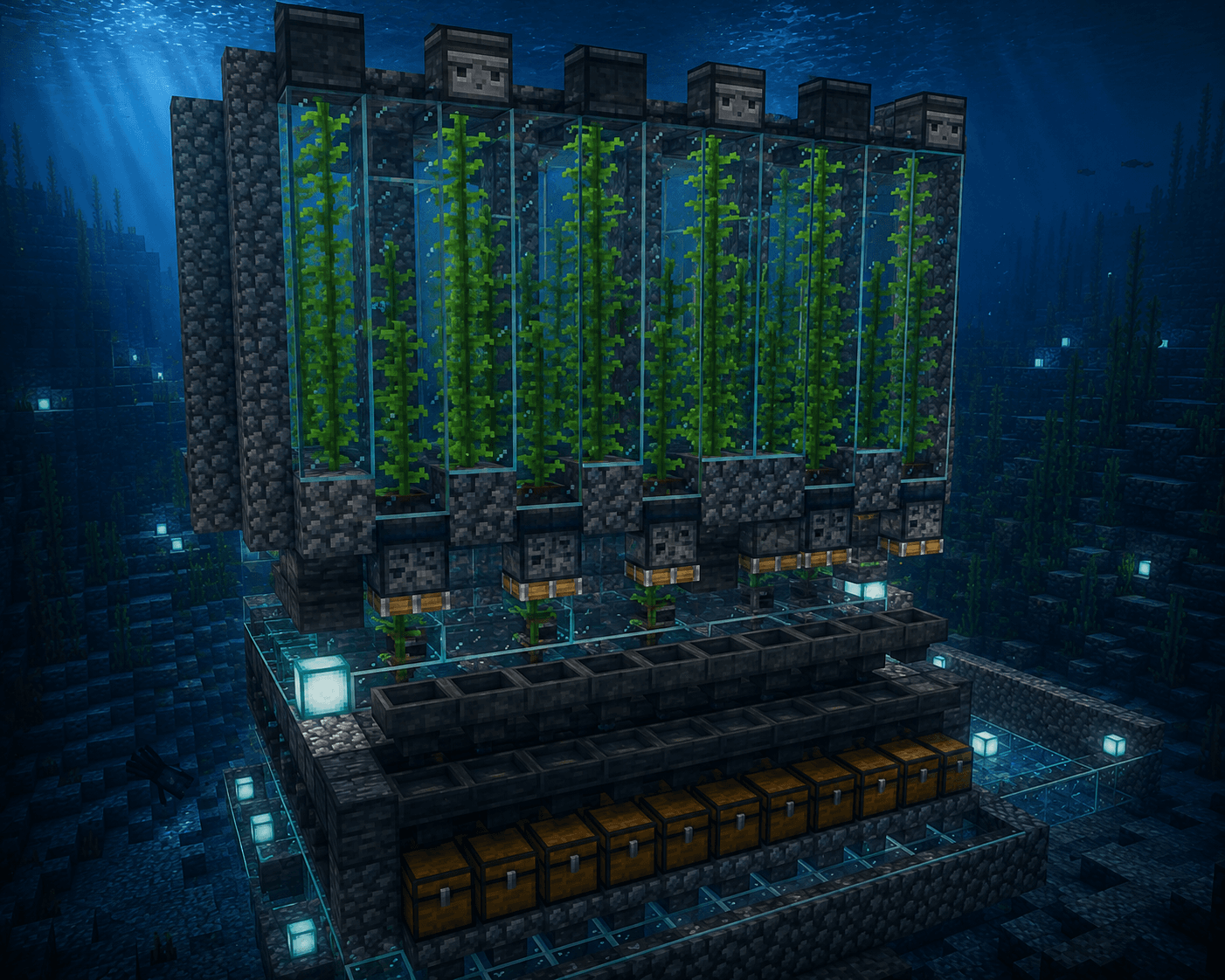

Kelp is one of the most efficient renewable resources in Minecraft, offering excellent fuel value and the ability to cook food at scale. An automatic kelp farm can produce vast quantities with minimal player interaction, providing a steady source of materials. This guide walks you through building your own efficient automatic kelp farm.
Why Kelp?
Kelp has several advantages as a farming choice. First, it grows incredibly fast—kelp plants generate new blocks every game tick when underwater, making them among the fastest-growing crops. A single piece of kelp can reach from the ocean floor to the water surface in seconds, providing an enormous harvest.
Second, dried kelp blocks provide fuel value comparable to coal but are infinitely renewable. A furnace can smelt approximately 20 items using a single dried kelp block, making it an excellent fuel source that never runs out.
Finally, kelp farms are relatively simple to build compared to other automatic farms. The basic principle uses water currents and gravity to collect kelp automatically without complex redstone contraptions, making them accessible to players of all skill levels.
Location Selection
Finding the right location is crucial for kelp farming success. Kelp grows exclusively underwater, so you'll need to build your farm in or near ocean water. However, consider building your farm in a location that's separate from your main base to avoid aesthetic issues—farms can be visually unappealing.
The ideal location is a flat ocean area at least 20-30 blocks deep. Shallow water doesn't provide enough space for kelp to grow to full height before harvesting. Additionally, finding a location away from existing ocean features prevents interference with natural water flow.
Consider the elevation of your farm relative to your base. Kelp farms with water elevators can transport you between levels efficiently, so positioning your farm strategically can serve dual purposes—resource generation and fast travel.
Basic Farm Design
The simplest automatic kelp farm uses a 2×2 or 3×3 grid of water columns. Each column grows kelp independently, and the farm's center features a collection area where kelp items flow toward for gathering.
Start by digging a trench in the ocean floor approximately 5-10 blocks deep. The width should accommodate your water columns—a 7×7 area allows for a 5×5 growing area with space for collection channels around the perimeter.
Place water source blocks for each kelp column. Kelp needs a water source block immediately above it to grow. Arrange these water blocks in your chosen pattern—2×2, 3×3, or larger depending on desired farm size.
Plant kelp stalks by placing one piece of kelp on the ocean floor beneath each water source block. Kelp grows upward, generating new blocks until it reaches the water surface. After a short time, you'll have tall kelp columns ready for harvest.
Harvesting Mechanism
The harvesting mechanism is the farm's critical component. Piston-based harvesters work well but require redstone. A simpler approach uses water currents and gravity.
Create a collection channel with a slight downward slope leading to a hopper or collection area. When pistons retract, they break kelp at a single height simultaneously across all columns. The broken kelp pieces fall and flow along the water current toward your collection point.
For fully automatic operation, connect pistons to a redstone clock. A simple clock using repeaters creates regular pulses every 5-20 game ticks. When the clock pulses, pistons fire and break kelp at their target height.
Alternatively, use observers positioned to detect growing kelp. When observers detect a new kelp block, they send a signal to the piston. This creates a mechanism where harvesting occurs whenever kelp grows, though it's slightly less efficient than a timed clock.
Collection and Processing
Once harvested, kelp flows along water currents toward your collection point. Position a hopper beneath the collection area to gather items automatically. From the hopper, items flow into a chest for storage or directly into a furnace for processing.
To create dried kelp blocks, arrange nine dried kelp items in a crafting grid. Furnaces can process raw kelp into dried kelp at approximately 20 items per dried kelp block. Consider building kelp into a fully automated cooking system using a redstone pulse to move items through a furnace into a drying chamber.
For massive production, build multiple furnaces side-by-side. An automatic sorter system can distribute kelp evenly across several furnaces, maximizing throughput and preventing bottlenecks.
Scaling Up
A basic 3×3 farm produces decent quantities of kelp. However, scaling up to 5×5, 10×10, or even larger grids increases production exponentially. Each additional column adds minimal complexity while substantially increasing harvest volume.
Space your farms vertically by building another farm 15-20 blocks below your first one. This vertical stacking dramatically increases total production within the same horizontal footprint, though it requires better lighting and access management.
Build multiple independent farms in different ocean areas. This redundancy ensures that if something damages one farm, you maintain production elsewhere. Multiple farms also allow you to optimize each one independently.
Automation Considerations
For full automation, connect your farm to a storage system. A simple hopper network flowing items to a central storage area works, though more sophisticated systems use item elevators and redstone logic to route items to specific locations based on availability.
Consider adding a display system where visitors can see your farm's production. A simple scoreboard or counter using droppers and comparators shows accumulated production over time, adding a display element to your farm.
Add safety features like covers over water channels to prevent accidental falls. While farms are functional, they should still be visually interesting and safe to navigate. Simple fencing or wall placement prevents accidents.
Fuel Generation
The ultimate goal—converting kelp to fuel—requires furnaces capable of handling massive kelp quantities. Build a room with several furnaces in parallel, each with its own input hopper. Distribute harvested kelp evenly across furnaces to prevent bottlenecking.
A fuel furnace room can provide fuel for your entire base's cooking and smelting needs indefinitely. Dried kelp blocks from your farm keep furnaces running perpetually, eliminating the need to gather wood, coal, or other traditional fuels.
Common Issues and Solutions
Insufficient water flow prevents kelp items from reaching collection points. Ensure water channels slope gradually toward collection areas. Add source blocks to water channels if items stop moving.
Kelp growing too slowly indicates insufficient lighting. Underwater lighting is complicated, but ensuring adequate light levels (even from lava) improves growth rates. Consider building your farm in a more lit location or adding lighting directly.
Collection hoppers filling with non-kelp items (fish, squid remains) can occur if your farm has visibility to ocean creatures. Enclose collection areas better or use a more sophisticated filtering system to prevent item collection from undesired sources.
Conclusion
An automatic kelp farm represents an excellent investment of building time for massive resource returns. Whether you're providing fuel for your base's furnaces or converting dried kelp to blocks for storage, a well-built farm serves your base for the entire game length. Start small, optimize, and expand to create an efficient system that provides valuable resources with minimal player interaction. Your furnaces will never run out of fuel again.