
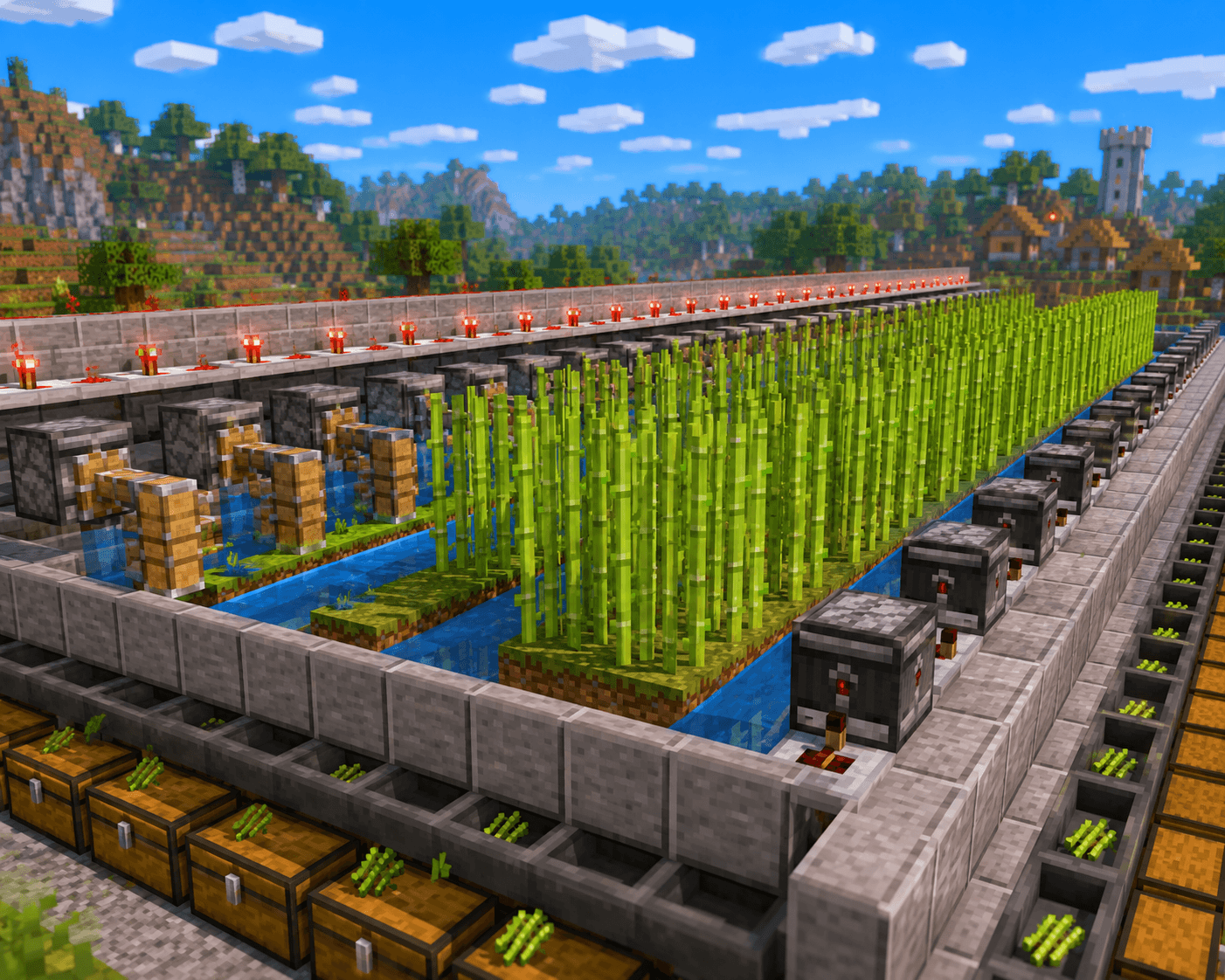

Sugar cane is one of Minecraft's most essential crops. You need it for paper (books, maps, bookshelves, cartography tables), sugar (potions, cake, pumpkin pie), and most importantly — bookshelves for your enchanting setup. Building an automatic farm means you'll always have a steady supply without lifting a finger.
Why Automatic?
A manual sugarcane farm requires you to be present to harvest. An automatic farm harvests itself using observers (which detect block changes) and pistons (which break the cane at the second block). It runs 24/7 and feeds into a collection system — you just come back and grab your haul.
What You Need
For a basic 5-column automatic farm:
- 10 Observers
- 10 Pistons (regular, not sticky)
- 1 Hopper
- 1 Chest
- 10 Sugar Cane (for planting)
- Water source
- Dirt or sand (sugarcane grows on both)
- Building blocks of your choice
Scale up by repeating the column pattern.
How the Farm Works
The logic is simple:
- Sugar cane grows to 3 blocks tall naturally
- An observer watches the sugar cane block at height 1 (the planted block)
- When it detects the block above change (i.e., the cane grows to height 2), it sends a redstone pulse
- The pulse activates a piston at height 2, which breaks the cane at that level
- Everything above height 1 drops as items
- A hopper under the water channel collects the drops into a chest
The planted base block (height 1) is never broken, so the cane regrows automatically and the cycle repeats.
Building the Farm Step by Step
Step 1: Lay the Water Channel
Dig a 1-block-deep, 1-block-wide trench of any length (5–10 blocks recommended for a starter farm). Place water at one end — it flows and fills the trench. This is your collection channel.
Step 2: Place the Hopper and Chest
At the end where water flows (the lower end), place a hopper pointing into a chest buried in the ground. The hopper will suck in items flowing down the water current.
Step 3: Plant the Sugar Cane
Along one side of the water channel, place a row of dirt or sand blocks at water level. Plant sugar cane on each one. Sugar cane must be adjacent to water — each planted block should be touching the channel.
Step 4: Place the Pistons
Directly above the second block of each sugar cane column (one block above the dirt/sand, so at height 2 from the ground), place a piston facing inward toward the cane. The piston head should point toward the cane column.
[Piston] →  [Cane height 2]
            [Cane height 1 / base]
            [Dirt]
[===== Water channel =====]
Step 5: Place the Observers
Behind each piston (on the side facing away from the cane), place an observer with its face pointing toward the piston. The observer's "face" (the side with the carved face texture) watches the cane; its "back" emits a redstone signal into the piston.
Observer orientation: The face must point toward the sugar cane. If you place an observer while crouching and facing the piston, it should orient correctly — experiment if needed.
Step 6: Test It
Bone meal a sugar cane plant to force it to grow immediately. You should see the observer light up, the piston extend, and the cane drop into the water channel and flow into the hopper.
If nothing happens:
- Check the observer is facing the cane (not the piston)
- Check the piston is connected to the observer's output side (the back)
- Make sure the piston is at the correct height
Compact 1-Wide Tileable Design
For a space-efficient farm you can tile infinitely side by side:
Top view (each row):

[Observer][Piston] [Cane][Water][Cane] [Piston][Observer]
Mirror the pistons on both sides of the water channel to double output from the same channel length.
Zero-Tick Farm (Java Edition — Advanced)
In Java Edition, you can build a zero-tick piston that repeatedly pulses the sugarcane, forcing it to grow at extreme speeds. These farms produce hundreds of cane per minute but are more complex to build. For most players, the standard observer design is sufficient.
How Much Sugarcane Do You Need?
Here's a reference for planning your farm size:
| Goal | Sugarcane Needed | |------|-----------------| | 15 bookshelves (enchanting table max) | 135 sugar cane (45 paper + leather) | | Stack of paper (64) | 22 sugar cane | | Full set of maps | ~10 sugar cane | | Sugar for potions/cake | Minimal — 5–10 plants is plenty |
For a full enchanting setup, run a 10-column farm for a week and you'll have everything you need and more.
Expanding the Farm
The design is infinitely tileable. To expand:
- Add more columns along the same water channel
- Build multiple channels in parallel with a central collection chest
- Stack the farm vertically with multiple floors (each needs its own observer/piston layer and water channel with hopper connecting to the same chest below)
A 10×5 farm (10 columns, each running 5 plants) provides enough sugar cane for all practical purposes, including active trading with librarian villagers.
Final Tips
- Sand vs Dirt: Sugarcane grows at the same rate on both — use whatever you have more of
- Lighting: Sugar cane doesn't need light to grow, but light prevents mob spawning in the farm area
- Growth rate: Sugarcane grows one block roughly every 18 minutes (1 game tick per random update). An automatic farm just captures each growth cycle immediately
- Use the cane for paper: Paper + Leather → Book → Bookshelf (3 books = 1 bookshelf). You need 45 books (135 paper = 270 sugarcane) for a full 15-bookshelf enchanting setup
Set this farm up in your first week and the rest of the game becomes dramatically easier. Infinite paper, endless enchanting, and passive sugar income — for just 30 minutes of setup.