
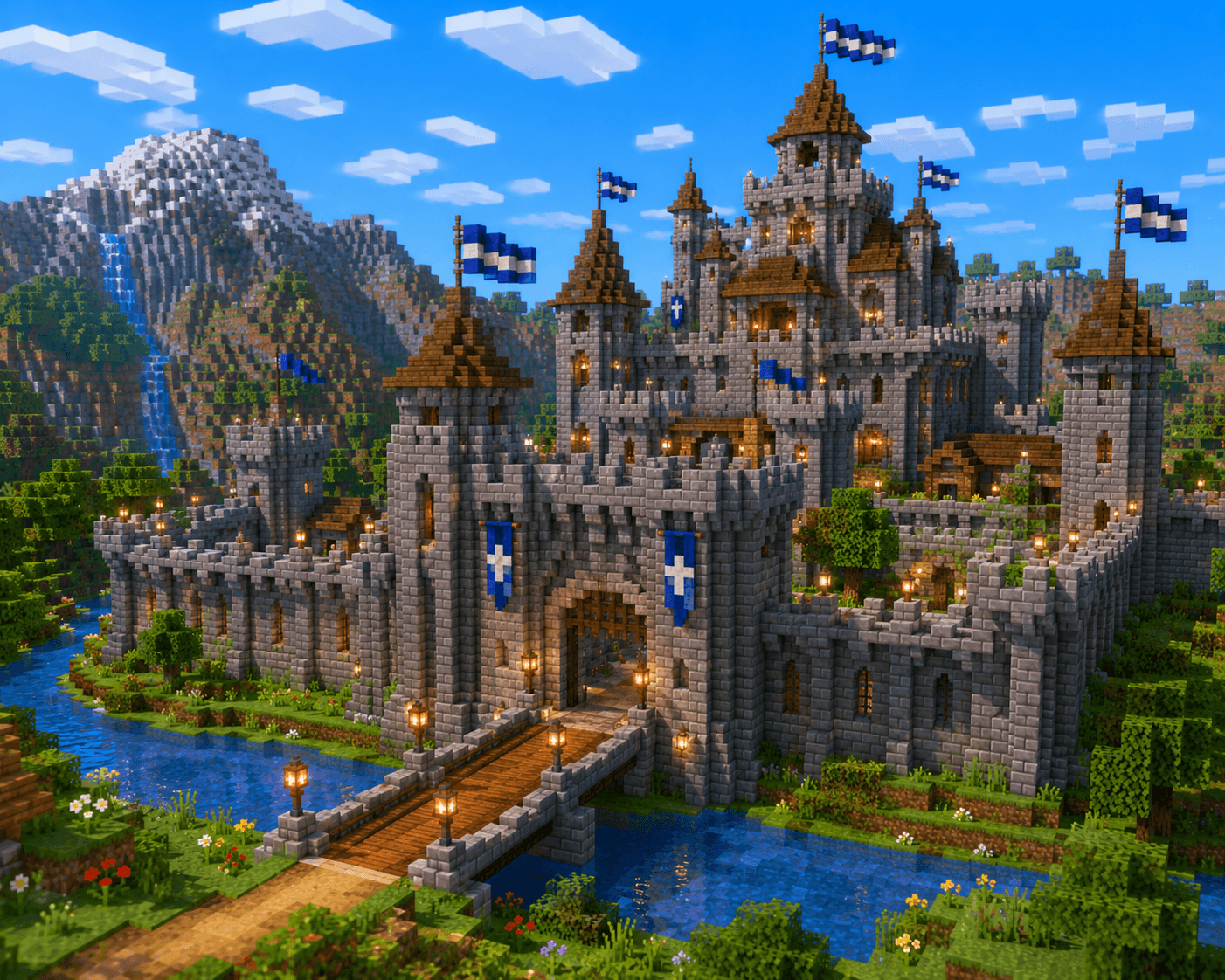

A medieval castle is one of Minecraft's most iconic builds — and one of the most rewarding. This guide walks you through building a functional, impressive castle from the ground up: location, materials, layout, walls, towers, keep, and interior. Whether you're a beginner or an experienced builder, there's a lot to work with here.
Choosing Your Location
Location shapes everything about a castle. The best spots offer:
- A hilltop or elevated terrain — castles historically dominated the landscape; elevation makes yours look more imposing and natural
- Near water — a river, lake, or ocean allows for a moat and makes your castle look grounded in its environment
- Open surroundings — you want to see your castle from a distance; clear the area around it for visual impact
- A relatively flat building pad — excavate if needed, but avoid building on steep slopes that complicate the footprint
For a starter castle, find a plains or savanna biome with a small hill. It takes 10 minutes to level the ground and the payoff in visuals is massive.
Choosing Your Materials
Material choice defines the mood of your castle.
Classic Medieval (Stone)
- Stone bricks — main walls; the classic castle look
- Cracked stone bricks — adds age and texture (use sparingly, 10–20%)
- Mossy stone bricks — for lower walls, dungeon areas, moat edges
- Cobblestone — rougher sections, foundations, retaining walls
- Stone slabs and stairs — for detailing, crenellations, rooftops
Warm Medieval (Sandstone/Terracotta)
- Smooth sandstone and cut sandstone — warm, Mediterranean feel
- Terracotta (orange, red, brown) — rooftops and accents
- Stone and stone bricks — structural elements
Dark Fantasy
- Deepslate bricks and tiles — darker, more threatening look
- Blackstone and polished blackstone — fortress feel
- Dark oak — gates, floors, frames
For this tutorial we'll use the classic stone approach.
Castle Layout
Before placing a single block, plan your footprint on paper or in-game.
Recommended Beginner Layout (40×40 outer wall)
+------+------+------+
|      |      |      |
+  WT  + KEEP +  WT  +
|      |      |      |
+------+  ##  +------+
|  ##  |  YD  |  ##  |
+  WT  +------+  WT  +
|      |  GT  |      |
+------+------+------+
(WT = Wall Tower, KEEP = Main Keep, YD = Courtyard, GT = Gate Tower)
- Outer walls — 40 blocks square, 6–8 blocks tall
- Corner towers — 6×6 base, 12 blocks tall
- Gate towers — flank the main entrance, 8×8 base
- Keep — central building, 16×16 minimum, 20+ blocks tall
- Courtyard — the open space between walls and keep
Step 1: The Outer Walls
Height: 8 blocks tall
Width: 3 blocks thick (1 interior, 1 main, 1 walkway ledge)
- Mark your 40×40 perimeter with a temporary material (dirt or wood)
- Build the wall 3 blocks thick — the inner block will be your wall-walk floor
- Add crenellations (merlons) at the top: alternate 2-block-high solid sections with 1-block-wide gaps. Classic battlements.
- Every 12–15 blocks, add a wall tower — these project 2 blocks outward, rise 2–3 blocks above the wall, and have their own crenellated top
Variation tip: Use a mix of stone brick and cobblestone (70/30) and randomly replace 5–10% of bricks with cracked or mossy variants. This texture break makes the wall look hand-built, not generated.
Step 2: The Gate
The gate is the visual centerpiece of the entrance.
- Cut a 4-wide × 5-tall opening in the front wall
- Frame it with stone brick pillars, 1 block thick on each side
- Add a portcullis using iron bars — fill the opening with iron bars in a grid pattern
- Build gate towers on each side of the entrance (8×8 base, 14 blocks tall, with crenellations)
- Add an arch above the opening using stone brick stairs and slabs
- Place a drawbridge effect using dark oak planks over a moat (if you have one)
For the moat: dig a 3-wide, 3-deep trench around the outer wall and fill it with water. Leave land connections at the gate (or add a bridge).
Step 3: The Corner Towers
Corner towers anchor the walls and define the castle's silhouette.
- At each corner, build a 6×6 circular tower (round towers use a stair-step pattern for each layer to create a cylinder from blocks)
- Height: 12–14 blocks (4 blocks taller than the walls)
- Add a conical roof using stone slabs in decreasing squares as you go up, or use log columns with a pointed top
- Include arrow slit windows — 1-wide × 2-tall openings facing outward
- Interior: add a spiral staircase using stairs and a center pole
Making circular towers from blocks: At each height level, use this 6×6 template:
. X X X X .
X X X X X X
X X . . X X
X X . . X X
X X X X X X
. X X X X .
(X = stone brick, . = air)
Step 4: The Keep
The Keep is the main building inside the walls — the heart of the castle.
Recommended size: 14×14 base footprint, 3 floors (each 4 blocks tall), with a top floor and roof.
Floor plan:
- Ground floor: Great Hall — a large open room with a fireplace (netherrack + iron bars), long tables (stone slabs + signs), and throne area
- Second floor: Living quarters — beds, crafting area, storage
- Third floor: Library/study — bookshelves, lecterns, enchanting table area
- Roof: Crenellated battlements with a flag (banner on a fence post)
Exterior features:
- Large windows (2×3 openings with glass panes)
- Buttresses on the outside walls (small stone brick projections every 4 blocks)
- Different roof treatment from the walls — try dark oak beams with stone brick filling
Step 5: Interior Courtyard
The courtyard brings life to the castle.
Add:
- A well (stone bricks in a circle with a trapdoor roof, water inside)
- Stables (3–4 stalls of dark oak with hay bales and horses if tamed)
- A small chapel — simple arched building with stained glass windows (white + purple)
- A garden — dirt path, flowers, lanterns
- Barracks — small building with beds for a guards aesthetic
- A blacksmith — crafting table, anvil, furnaces
These details transform an empty courtyard into a lived-in settlement.
Lighting
Lighting keeps the castle safe and atmospheric:
- Lanterns on fence posts along wall-walks and paths
- Torches in wall recesses inside the Keep
- Glowstone hidden under stairs or inside fireplaces for consistent light
- Sea lanterns for a more magical look in tower tops
- Campfires in the courtyard for ambiance
Decorative Details That Elevate the Build
- Banners on the Keep walls in your chosen colors — use armor stands to display weapons
- Trapdoors on windows as shutters
- Flower pots on window ledges
- Item frames with maps, tools, or trophies
- Barrels and chests in storage areas for a furnished look
- Vines on the outer walls — place vines at the top and let them grow down for a ruined/aged effect
Final Tips
- Work from outside in — build walls first, then interior structures; this establishes scale before details
- Step back often — fly up (spectator or creative mode) to check proportions every 20 minutes
- Don't be afraid of height — castles should feel tall and imposing; when in doubt, go 2–3 blocks higher
- Mix block types throughout — never fill a large wall with a single block type; alternate and add texture constantly
- Save materials first — for a full castle in survival, stockpile 1,000+ stone bricks before you start
A completed medieval castle is one of Minecraft's most impressive achievements. Take your time, build it in stages, and enjoy the process — it's one of those builds that gets more impressive the longer you spend on it.